Two cabin filters can look identical in product photos - same size, same color box, same carbon label - and perform completely differently on the road. The difference hides inside the media: how much activated carbon is loaded, how the electret layer captures fine particles, and whether the frame actually seals. This guide gives you five concrete checks to run before you wire a deposit, so the filters you import protect your customers instead of your return rate. That is why professional buyers evaluate activated carbon cabin air filters with real test data before signing a supply contract.
What a Cabin Filter Has to Do
A cabin filter has two jobs. First, particle filtration: dust, pollen and soot, down to PM2.5, must stay out of the cabin air stream. Second, adsorption: activated carbon captures ozone, exhaust gases and the VOC compounds that cause smells in dense traffic and hot climates. A filter that only does the first job is a particle filter wearing a carbon label - and your customers will notice within weeks.
For the market side of the category, see our guide on PM2.5 and activated carbon cabin filters for urban markets.
Five Checks Before You Place the Order
1. Activated carbon loading - ask for grams, not adjectives
There are two common ways to add carbon: granular carbon sandwiched between media layers, and carbon-coated foam. Granular loading works better and lasts longer, but costs more. The question to ask is simple: how many grams of carbon per square meter? Quality passenger-car filters typically carry roughly 50-80 g/m². A supplier who cannot answer with a number is selling you a label.
2. Dust holding capacity and pleat count
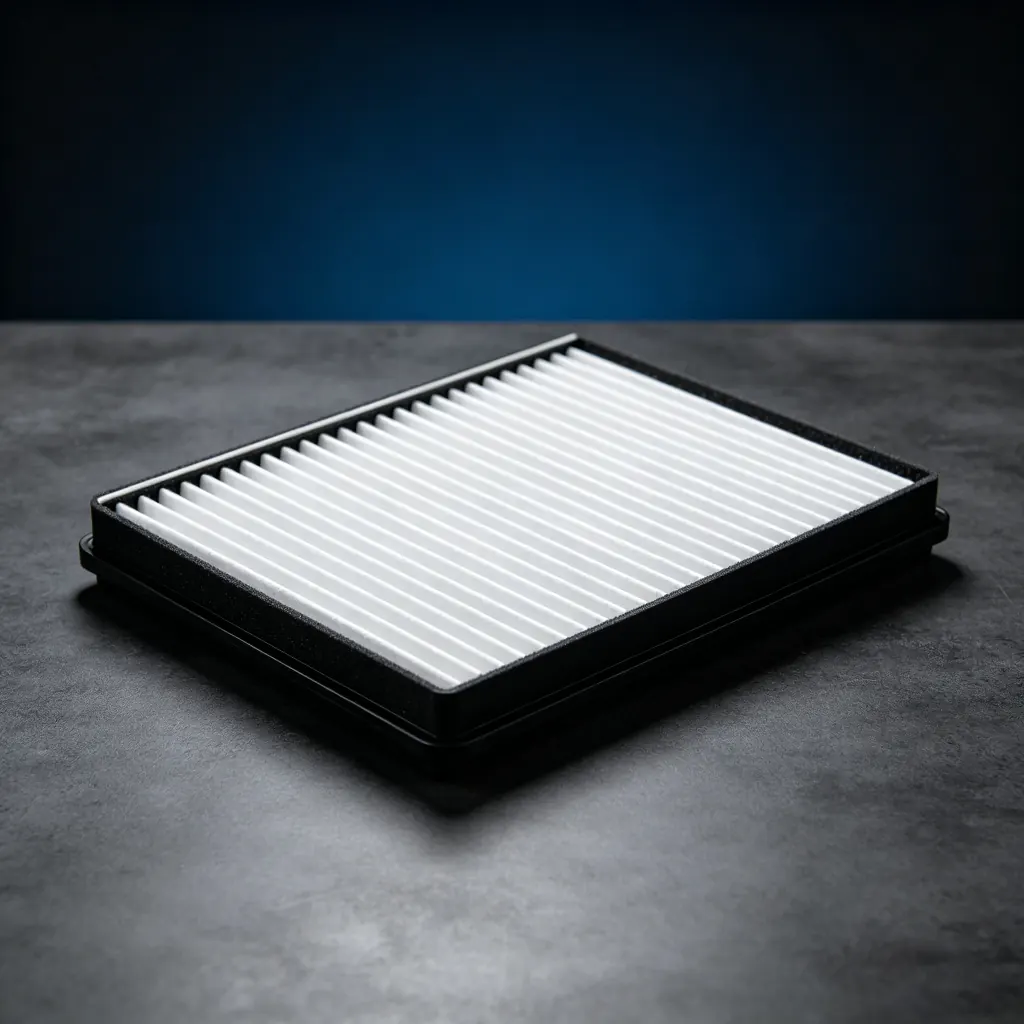
Pleat density decides how much surface area - and therefore how much dust - the filter can hold before airflow drops. More pleats, evenly spaced, mean longer service intervals: a real selling point in dusty markets. Compare pleat counts on the same filter size across quotes, and ask whether the meltblown layer is electrostatically charged, which improves fine-particle capture in the first weeks of use.
3. Frame, seal and glue quality
The media is only as good as its frame. Check that the PU frame is rigid but not brittle, that the sealant bead is continuous, and that end-caps are bonded without gaps. Poor sealing lets unfiltered air bypass the media entirely - the filter looks used but the cabin never got clean air. Also smell the sample: a strong chemical odor from cheap glue will generate returns on its own.
4. Fitment accuracy
A cabin filter is a sealed component: 1-2 mm of dimensional deviation causes whistling, rattling or air bypass. Ask which vehicle platforms the mold covers, how fitment is validated, and whether the supplier accepts cross-referencing against your top OEM numbers before production. Fitment complaints are the most common reason distributors lose repeat customers in this category.
5. Test reports you can read
Ask for batch test data, not certificates alone: particle efficiency (especially in the 0.3-2.5 µm range), pressure drop, and - for carbon filters - adsorption performance. Standards like DIN 71460 give you a common language across suppliers. If a quote is 20% below the market with no test data behind it, the discount is coming out of the media.
Red Flags When Comparing Quotes
- Activated carbon with no gram weight and no visible granules in the sample
- Identical price across all media grades - real carbon costs more than foam spray
- No batch test reports, or reports without measurable numbers
- Samples that smell strongly of glue or have uneven pleat spacing
- Refusal to cross-check fitment against your OEM numbers before production
How BAIKUAN AUTO Supports Cabin Filter Buyers
We work as an exporter and quality-control partner: we specify the media grade and carbon loading for each model, inspect batches on IATF 16949-certified production lines, and manage export packaging and documentation. Send us your top 30 cabin filter OEM numbers and we will match cross-references and quote FOB Qingdao or Tianjin with identical specs, so your comparison is honest. Samples ship in 7-10 days with freight collect; the minimum order is 500 pcs per model with a 25-30 day lead time and a 12-month warranty.
Conclusion
Cabin filter quality is decided by three numbers - carbon loading, pleat count, fitment tolerance - and by the paperwork behind them. Ask those questions before the deposit and your category returns stay low. Browse our cabin filter range, check the FAQ for trade terms, or request a quote with your OEM list.
Frequently Asked Questions
How can I tell if a cabin filter really contains activated carbon?
Cut the media open or check the weight. A carbon-loaded filter is noticeably heavier than a particle-only filter of the same size, and granular carbon is visible between the pleats. Ask the supplier for the carbon loading in grams per square meter - serious suppliers answer with a number, not a brochure.
What carbon loading is considered standard?
Quality passenger-car cabin filters typically carry roughly 50-80 g/m² of activated carbon. Below that range, odor and VOC adsorption fade quickly; far above it, you pay for media the airflow barely touches.
What are typical MOQ and lead times for cabin filters?
From BAIKUAN AUTO, the minimum order is 500 pcs per model, with a lead time of 25-30 days after deposit. Samples are dispatched within 7-10 days with freight collect.
Do you provide test reports with each batch?
Yes. Every batch ships with inspection reports covering filtration efficiency and pressure drop; third-party inspection (SGS or your own agent) is welcome before loading.